

The US Navy's Cargo Submarines
GIANT SUBMARINES - Part 1


From the earliest days of the submersible, engineers dreamed of undersea vessels able to haul cargo, fuel and troops beyond the reach of enemy guns. This first of two articles traces how the US Navy pursued that dream — from Simon Lake’s rejected cargo-submarine schemes and the desperate resupply of besieged Corregidor to the Cold War’s audacious nuclear-tanker projects. Part two will carry the story into the missile age — and to the giant transport submarines that never were.
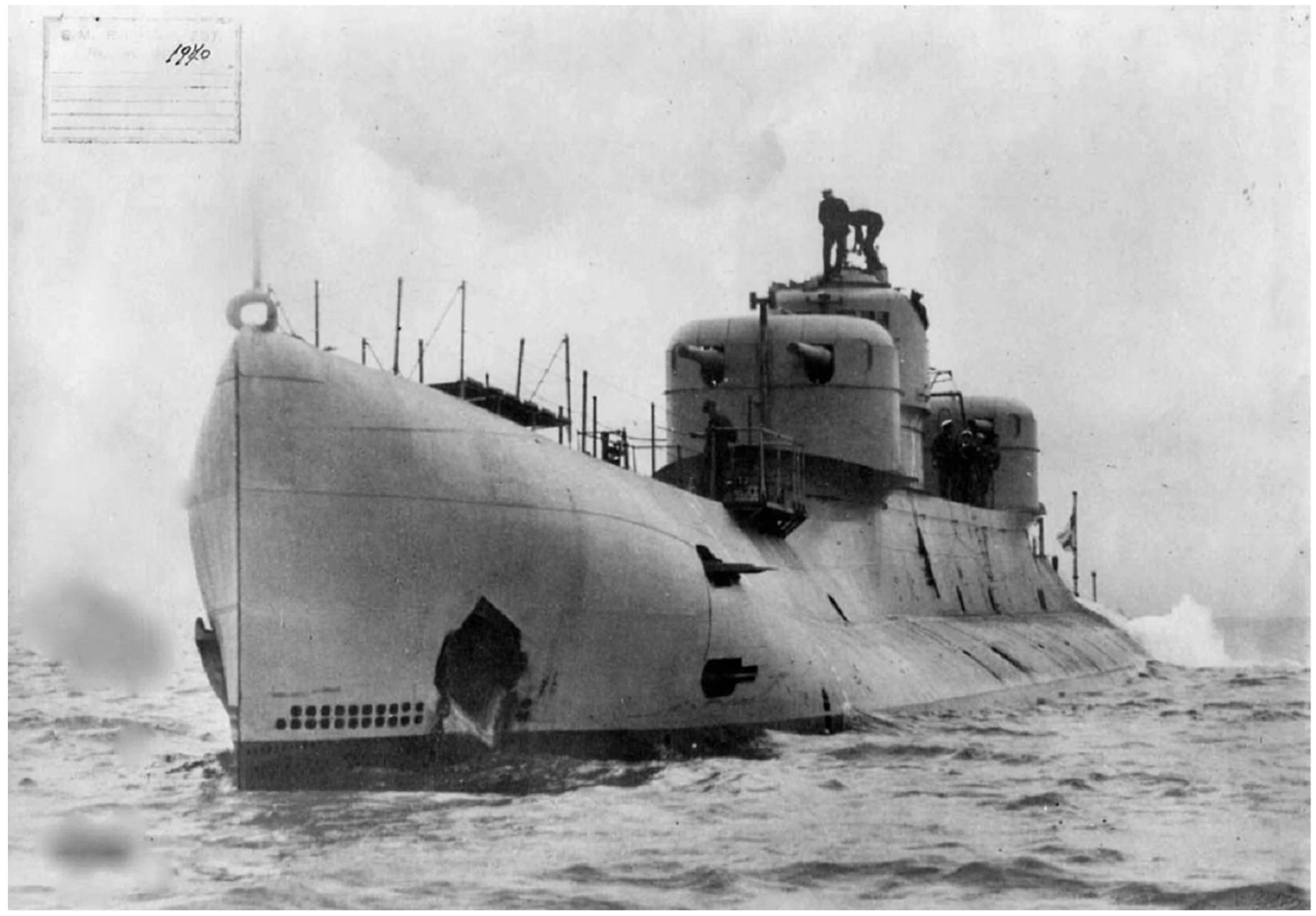
From the very first appearance of the submersible, engineers worked to make it larger, with the aim of having it carry ever-bigger guns, aircraft, missiles, but also troops or assorted cargoes — above all oil. And so gigantic craft appeared: from 1917, the K1 and K26, then, from 1918, the M-class “submarine monitors,” and finally the X1 submarine cruiser among the British and the impressive Surcouf among the French in 1934. Although they had considerable internal volume, heavy-caliber artillery pieces, even an aircraft hangar, these vessels were not, strictly speaking, transport submarines: they had no holds in which to store cargo, nor living quarters for the troops being ferried.
The pioneer in this field was none other than the Deutschland, built in 1915–1916 by Germany. The very genesis of the project may well trace back to a meeting between Alfred Lohman, director of the firm that operated the Deutschland, and the American engineer Simon Lake in 1909. According to his autobiography, it was Lake who suggested to Lohman that he build a submersible freighter, an idea of dubious commercial interest in peacetime. In wartime, however, the concept gained relevance, and during its call at Baltimore in June–July 1916 the Deutschland is said to have received a visit from Simon Lake, who reportedly took the opportunity to wring from the Germans their agreement to build several more cargo submarines in the United States. The project would never see the slightest beginning of realization, however: it is possible that with the Bremen — the second such vessel built by the Second Reich — the financial credits needed to begin construction also vanished, in September 19161.
Simon Lake’s Attempts
When the United States entered the war in April 1917, Lake changed tack and tried to convince the American authorities of the merits of a fleet of cargo submarines: “For the same weight, a transport submersible can prove safer in operation, and more economical to run in peacetime, than an ordinary surface ship,”2 he argued first to the Navy — which rejected his idea — then to the US Shipping Board, which listened more attentively. He proposed a design capable of carrying 7,500 metric tons of cargo for a total displacement of 11,500 metric tons (≈12,680 short tons), that is, 65%.
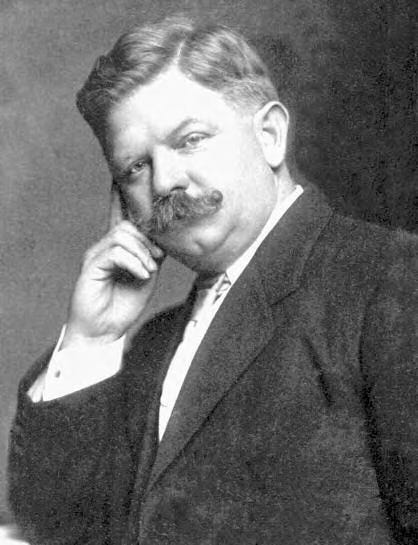
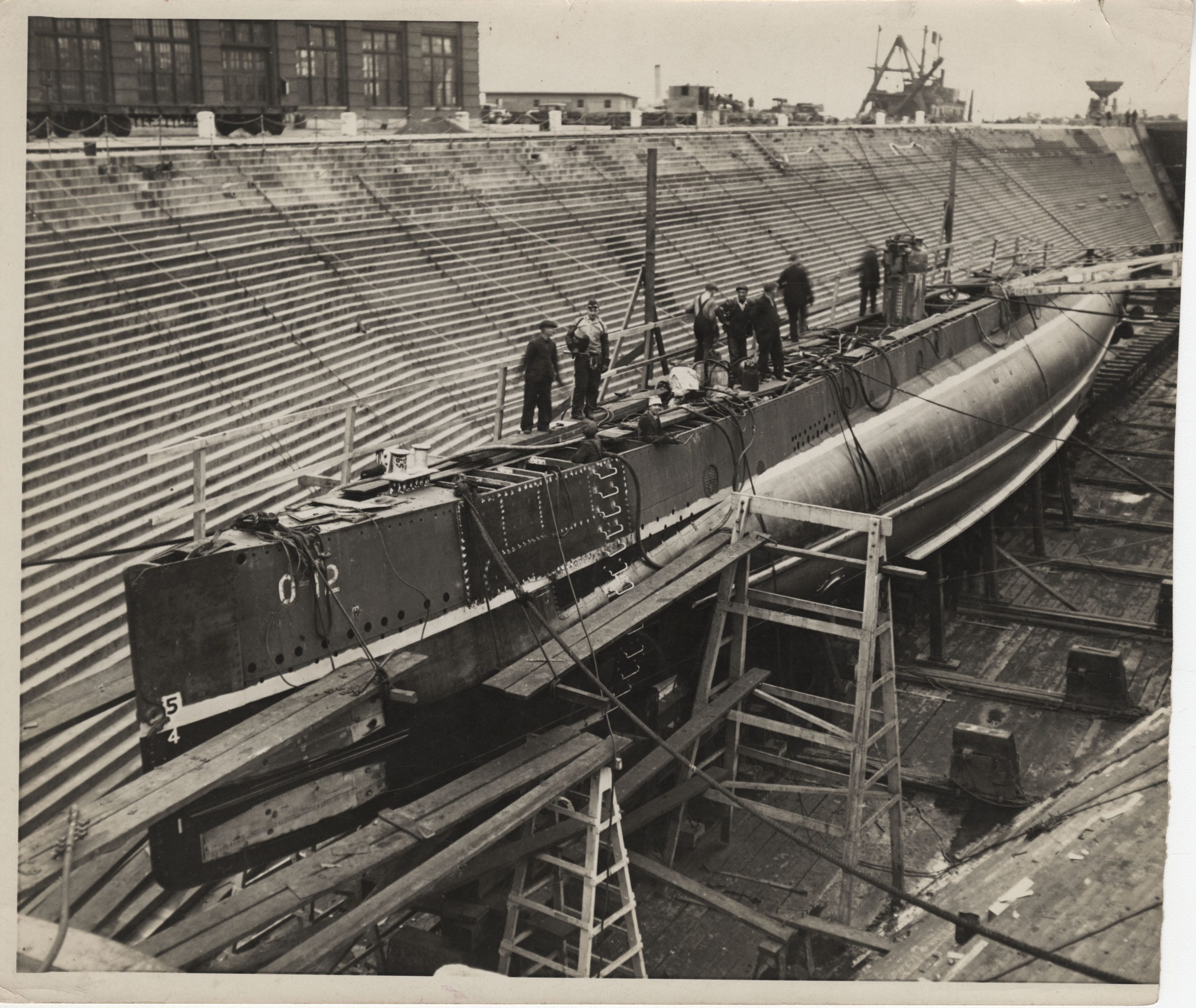
Still according to his autobiography, the project was accepted by the head of the US Shipping Board, who envisaged producing some hundred of them in time. Lake then set to work organizing “assembly-line” production, in cooperation with the Emergency Fleet Corporation. The latter, responsible for technical feasibility and production, decided to build only six submersibles at first. Past fifty, Simon Lake nonetheless saw in this the long-awaited fruit of his efforts to get his plans accepted by his country’s navy. But in August 1917 everything changed: the Shipping Board and the Emergency Fleet Corporation gave way to a new administrative authority, the Committee on Standard Ship Construction, which rejected the file for good. The end of Simon Lake’s hopes? Far from it! The man would go on arguing in favor of submarine transport — in vain — until his death in June 1945. He also became passionate about the underwater crossing of the poles and designed an “arctic submersible” with numerous innovations, the most visible being a telescoping conning tower able to pierce the ice pack. The craft was never built, but in 1931 Lake took part in preparing the Wilkins-Ellsworth Arctic expedition, making many modifications to the American submarine O-12, rechristened Nautilus for the occasion.
The Lessons of War
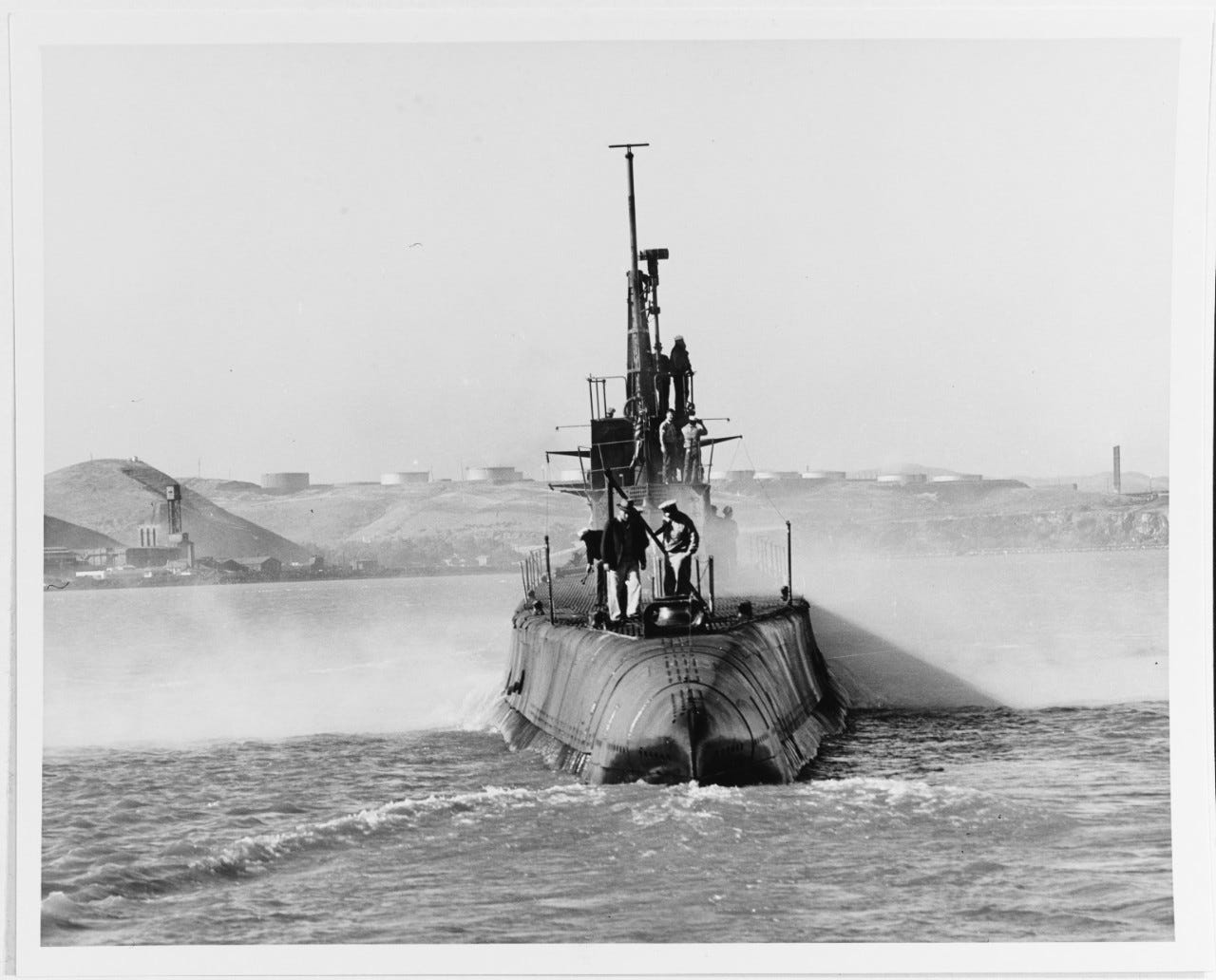
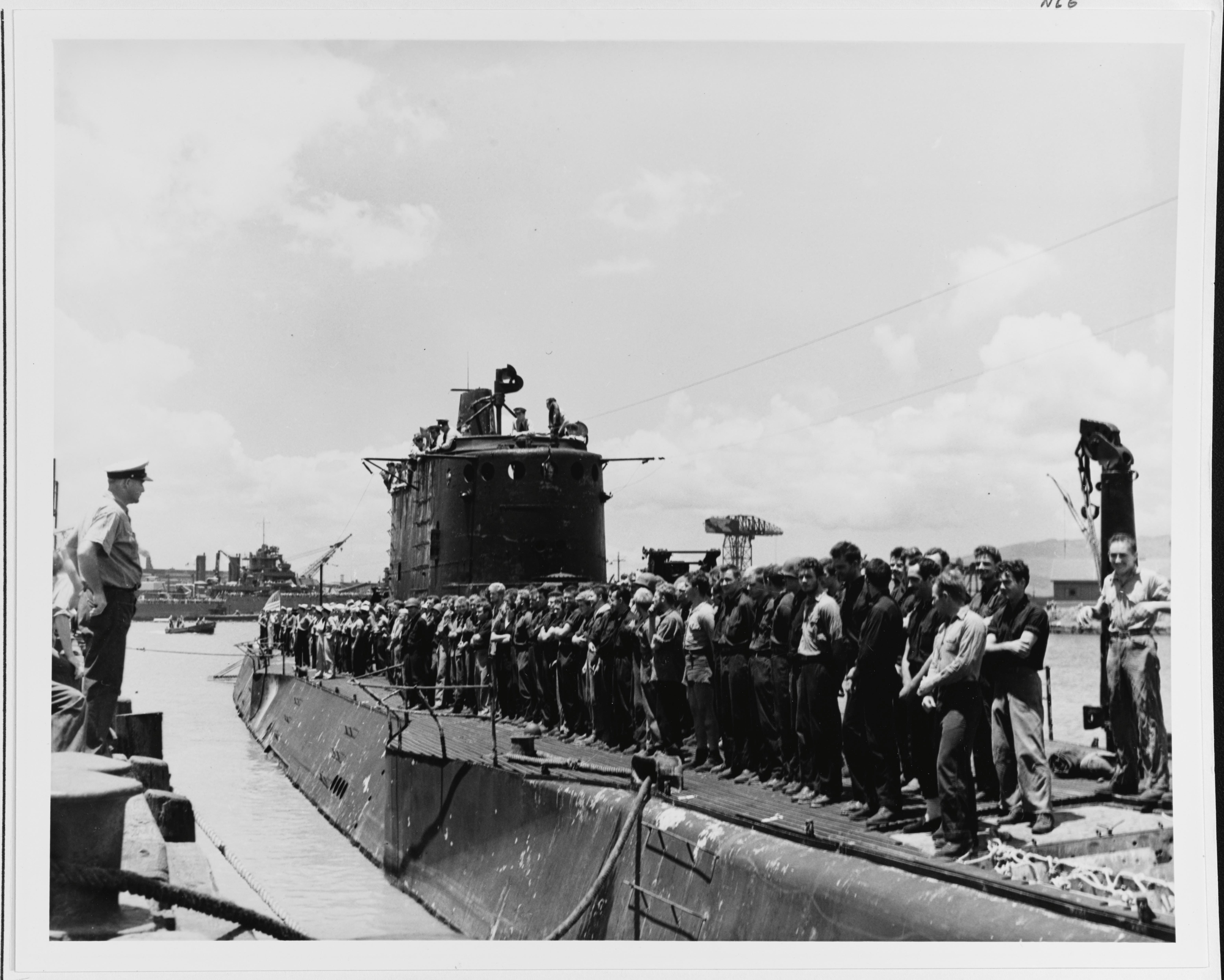
While Lake’s proposals seemed rather far-fetched, the general concept remained tactically appealing, something the US Navy discovered somewhat late: as early as 1942, the Americans had to call on their submarines for transport missions. Their garrison at Corregidor was cut off from its supplies by the Japanese troops advancing in and around Manila. To evacuate the personnel not essential to the island’s defense (nurses, communications specialists, and so on), the Navy sent oceangoing submarines to run the blockade of the imperial fleet. To increase their carrying capacity, they left most of their torpedoes on the dock. The lesson bore fruit, and throughout the war the US Navy did not hesitate to use its submarines as “taxis of the Pacific” to evacuate civilians or American nationals from war zones, land spies or commandos, rescue downed pilots at sea, and so on.3 Such missions generally involved only a very limited number of passengers and came only as a supplement to more conventional priority missions (torpedo attacks, reconnaissance, etc.). Even so, the need for submarine transport seemed real, and President Roosevelt eventually asked the Navy to develop such vessels: three old Barracuda-class submersibles were thus converted, but they proved unsatisfactory and were never used as freighters. The needs were nonetheless growing ever more pressing: not only would the US Marine Corps in the Pacific have badly needed transport submarines to move men or supplies discreetly from one island to another, but in the Atlantic and the Arctic the convoy war was raging and merchant-ship losses were mounting. Then heavily dependent on the arms and materiel supplied to him by the United States, Stalin himself raised the matter with the ambassador posted to Moscow, Admiral William H. Standley: “Why don’t you build cargo submarines? They could cross the oceans without being intercepted by the U-boats and could bring their cargoes directly into our own ports without danger of being sunk.”4
Submarines to Resupply and Evacuate Corregidor
In March 1942, all the intelligence gathered by USFIP (US Forces in the Philippines) pointed to the Japanese preparing a large-scale offensive to seize the Bataan Peninsula and thus fully secure the island of Luzon before the start of the rainy season in June. Declared an open city, Manila had fallen in January, and since then 109,000 men (Americans and Filipinos, military and civilian) had been fighting with the energy of despair, hemmed in on the mountainous peninsula and a handful of islands blocking access to Manila Bay. In January and February they had repelled several Japanese assaults, but, cut off from their supplies, their situation was growing ever more critical: “From 9 January to 15 March, [they] subsisted on less than half a Philippine ration per day. Since then it has amounted to less than a third of a Philippine ration. [...] Our food stocks will be exhausted on 12 April,” warned one report.5 Medicines were also running short, quinine in particular, indispensable in this mosquito-infested region; some 7,000 severe cases of malaria were recorded (and more than 9,000 others not requiring hospitalization)! The authorities reckoned the American-Filipino forces were at only 30% of their combat effectiveness.
On 12 March, MacArthur left Bataan aboard a patrol boat; resistance nonetheless continued. Yet beyond the lack of food, the main problem facing the defenders remained air attack: Japanese aircraft flew over the American positions at 6,700 m (~22,000 ft) with no fear of the anti-aircraft defenses, because their 76.2 mm (3-inch) guns had only shells fitted with old fuzes unable to reach beyond 6,000 m (~19,700 ft)! Those able to fire to 9,000 m (~29,500 ft) were all stored at Cebu, an island still held by the Americans and overflowing with stocks of food, medicine and ammunition, but lying 600 km (~373 miles) further south... An airlift was out of the question (too few aircraft), and a convoy of surface vessels would surely have been wiped out by the enemy naval units patrolling off Corregidor. The only possible solution was to call on the seven American submarines of the 14th Naval District operating in the sector from the Australian port of Fremantle. The US Navy estimated that each could take on a cargo of 40 or 50 metric tons (≈44–55 short tons) — that is, “three months’ worth of medical supplies and AA fuzes, and enough food [...] to raise the ration level for a week. Moreover, on their return trip, these submarines could each carry 25 people [...] as well as important documents.” The mission posed no insurmountable difficulty, all the more so as submarines had already made such runs in the preceding months: in January the Seawolf had brought from Darwin (an 1,800-nautical-mile voyage in 11 days) 700 crates of 12.7 mm (.50-cal) ammunition and 72 of 76.2 mm (3-inch) shells, then evacuated 25 pilots and 16 torpedoes from the Corregidor base, while the Trout brought 3,500 AA shells from Pearl Harbor. In return it took on 10 additional torpedoes as well as eight metric tons (≈8.8 short tons) of gold and twelve metric tons (≈13.2 short tons) of silver, a treasure removed from the Bank of Manila before the city fell.6 The Sea Dragon, for its part, was given the mission of evacuating the codebreakers of the “Cast” cryptanalysis unit. On 4 February it took aboard 25 people, 23 torpedoes and various cryptographic equipment. In February, the Swordfish carried to San Jose, on the island of Panay in the Philippines, Philippine President Quezon, his family, his advisers, the vice-president and the head of the Philippine Supreme Court, then the US High Commissioner to the Philippines, twelve members of his entourage and three codebreakers to Australia. Here is the testimony of Vince Chamberlin, one of the cipher specialists then present at Corregidor:7 “At that time, several [members of the ‘Cast’ team] would disappear each time a submarine reached Corregidor. I don’t know how those ‘departing’ were chosen; I do know that all departures took place at night. We only became aware of them when, the next morning, it turned out that some were missing. It then fell to us to clear out their desks, to stow their abandoned clothes in a ‘Lucky bag’ kept in the Code room, and to hand over all their cigarettes to Pappy Lowery, who was in charge of rationing.” For these evacuations, the submarines were generally diverted from their patrols mid-mission. The Permit evacuated 36 “Cast” cryptanalysts and linguists and 7 occupants of one of the four PT boats that had carried MacArthur to Panay but had broken down there. With eleven “guests” aboard, the Permit’s captain nonetheless pressed on with his primary mission, torpedoing in vain three Japanese destroyers that forced him to stay submerged for 22 hours before he could escape them! For such reckless conduct he would get a dressing-down from his superiors once he had reached Fremantle safely. The drawback lay rather in tying up such costly tactical assets for nine days (the estimated round-trip time), but the situation demanded it... And so the runs resumed: having left Fremantle at the end of March, the Snapper was ordered en route to make for Cebu to pick up supplies bound for Corregidor. But it was already very late! When it arrived off Bataan on 6 April, the Japanese were now so close that it could unload only a quarter of its cargo and take aboard 27 people (including the last members of “Cast”). Likewise, on 9 April, the Sea Dragon could offload only half its load and evacuate 25 people in exchange. The next two missions, by the Swordfish and Searaven, had to be cancelled at the last moment, with the boats in sight of Corregidor, in the face of the increasingly threatening Japanese advance. Finally, two nights before the Japanese landing on the island on 5 May, the Spearfish carried out one last mission to bring back twelve officers, twelve nurses and one civilian woman. This series of resupply/evacuation operations was carried out without a single loss.
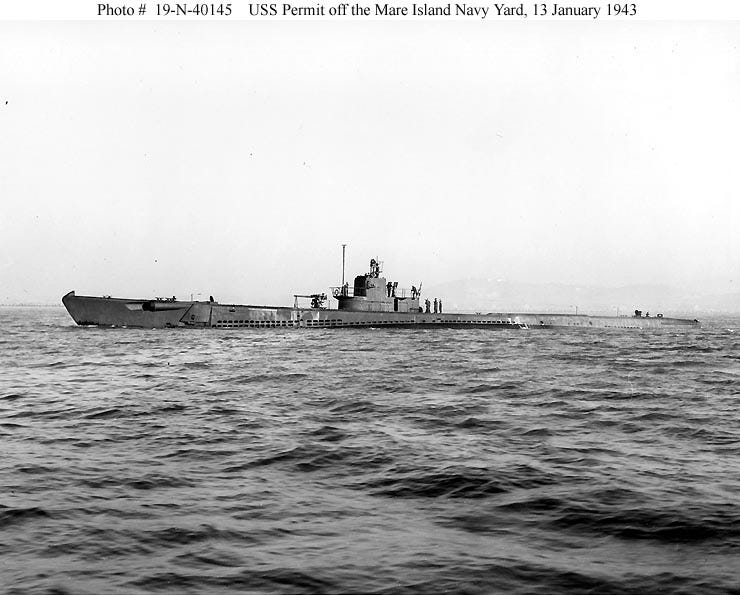
In fact, the US Navy focused its research rather on using the submarine as an amphibious transport to project an armed force into enemy territory. This, then, was tactical transport — not the strategic kind Stalin had in mind. During the war, three craft — the minelayer Argonaut (SM-1, SS-166 or APS-1) and the Narwhal (SS-167) and Nautilus (SS-168) — were used in two major tactical-transport operations. In early August 1942, the Argonaut and the Nautilus offloaded their reserve torpedoes to take aboard some 219 Marines. On 17 August, the two vessels surfaced off Japanese-held Makin (Marshall Islands), and the contingent reached the beach in inflatable boats. The commando operation was led by Major James Roosevelt, the president’s son: 46 of the 70 Japanese present were killed, against 30 Marines. On 11 May 1943, after a “rehearsal” at Dutch Harbor in April, the Nautilus and the Narwhal were used to put 200 men ashore on the Aleutian island of Attu (occupied by the Japanese since June 1942) as part of Operation “Landcrab.”
A Submarine Made of Cement!
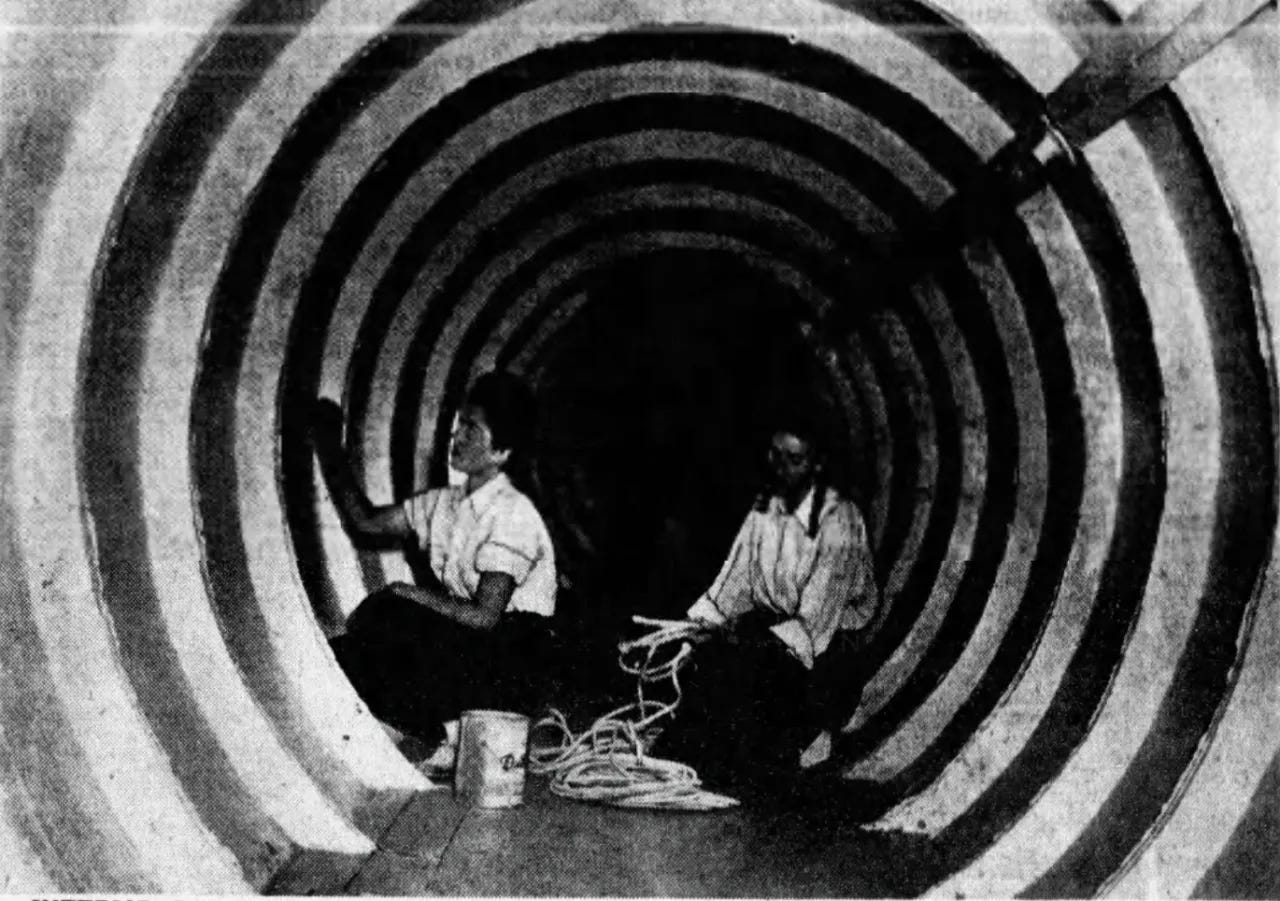
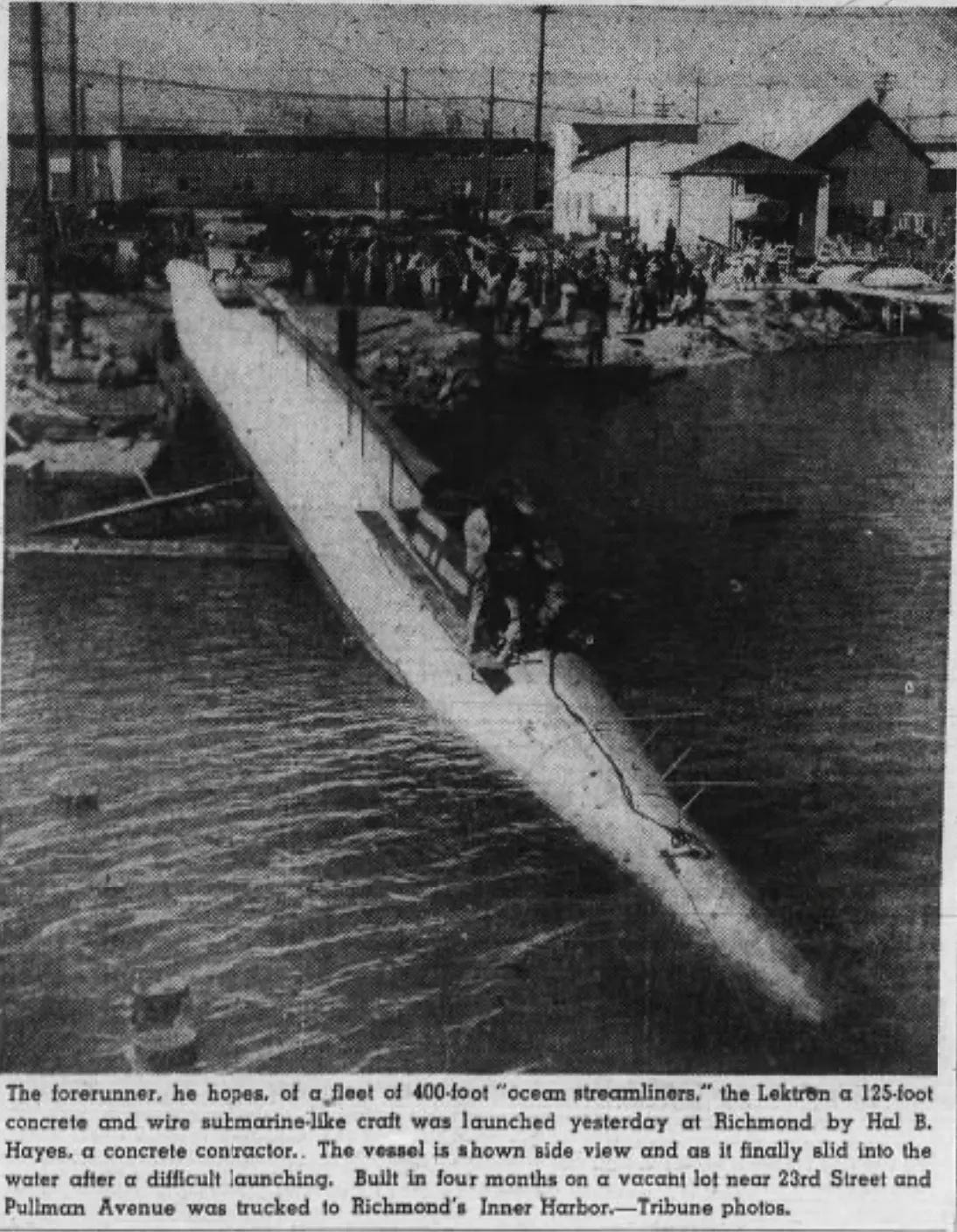
In 1943, the Californian cement contractor Hal B. Hayes designed, with his own funds, a prototype submersible vessel made of ferrocement. The technique was not new in itself: the first reinforced-cement barge dates back to 1848 (in France, by Joseph-Louis Lambot), and during the interwar years concrete ship hulls proliferated as an economical replacement for vessels sunk in the conflict. Ferrocement is convenient to work with, particularly ductile, and far cheaper than steel. Hayes thus proposed replacing the C2 freighters — the famous Liberty Ships — with vessels derived from his prototype, itself only a quarter-scale model: he launched the latter at Richmond, California, in August 1943. Shaped like a stylus, highly hydrodynamic, 38 m (125 ft) long and only 2 m (6.5 ft) wide, the Lektron weighed just ten metric tons (≈11 short tons) and was driven by two Ford V-8 engines to reach 20 knots. Its designer was adamant: the final model (213 m / 700 ft long by 12 m / 39 ft wide) would reach 50 knots, even 80, while carrying a load far greater than a conventional freighter’s and using 90% less steel to build! The delusion of a mad scientist or the swindle of an opportunist? The US Navy declined the project even though a first trial proved rather encouraging, perhaps because the craft was not a submarine but a “semi-submersible,” able to submerge only three-quarters of the way. Ease of production and economies of scale thus seem not to have convinced the US Navy, perhaps too timid and already deeply committed to the Liberty Ship program.
The Bremen most likely struck a mine on its first transatlantic voyage.
Simon Lake, Submarine: The Autobiography of Simon Lake, p. 264.
The last mission of the Pacific War is said to have been the exfiltration of agents from the Celebes (Indonesia) by USS Caiman in August 1945.
Standley, Admiral Ambassador to Russia, Chicago, Henry Regnery, 1955, p. 156
Report S-172 by Colonel S. Wood, staff of US Forces in the Philippines, 20 March 1942.

Extracts from Intercept Station “C” from Olongapo through the Evacuation of Corregidor, 1929–1942, published by the Naval Cryptologic Veterans Association. Vince Chamberlin would be evacuated on 9 April by the Seadragon.
 | A guest post by
|