

The GIANT Cargo Submarines Projects
Part 2 : A Concept Revived by the Cold War


In October 1945, a memorandum from the US Chief of Naval Operations proposed developing five specific types of submarine: attack, guided-missile launcher, cargo/transport, reconnaissance, and midget submarine.
The contribution of German technology (Type XXI U-Boat) and the many technological experiments (the GUPPY program) in the postwar years classified these specialized craft still further — cargo carriers (designated SSA or ASSA), tankers ( SSO or ASSO) and troop transports ( SSP or ASSP) — and, as early as 1948, the US Navy converted several boats to run trials:
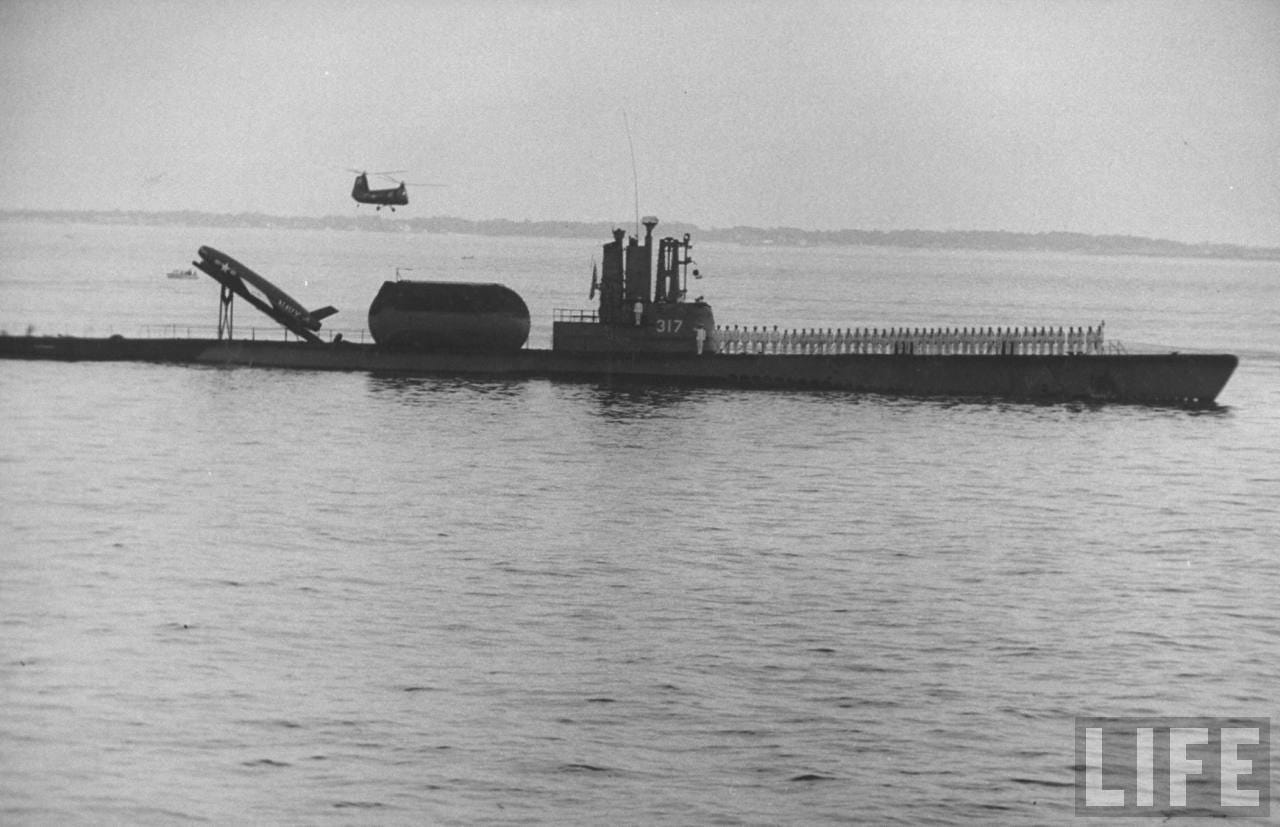
The Barbero (SS-317, then SSA-317 and ASSA-317) was thus rebuilt at Mare Island in 1948: its four stern torpedo tubes were removed, and the space thereby freed allowed it to carry 100 metric tons (≈110 short tons) of aviation fuel or 120 metric tons (≈130 short tons) of “dry” cargo. It took part in several exercises from October 1948. Of limited value, it was set aside in June 1950, then converted into a Regulus missile launcher.1
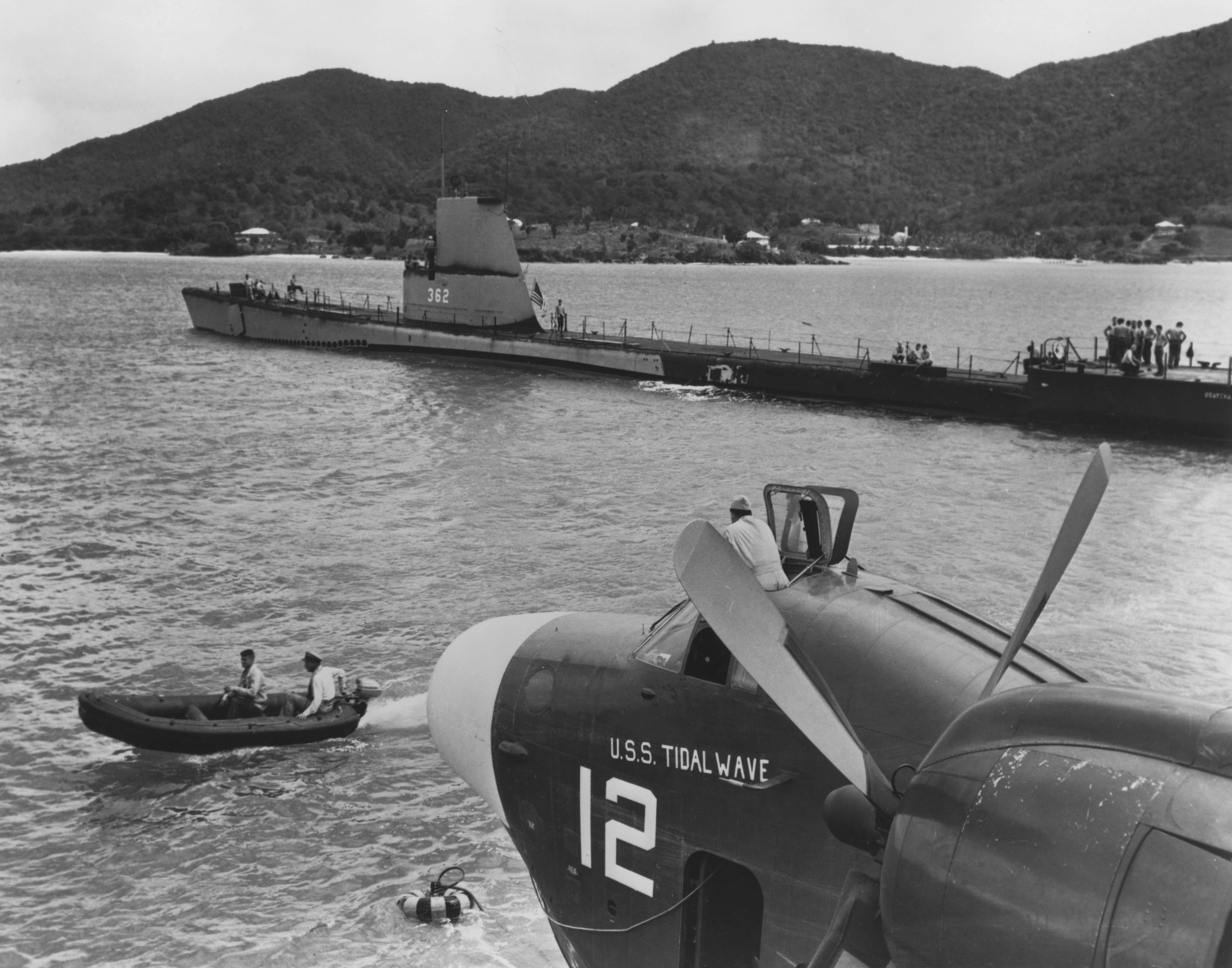
The Guavina (SS-362, then SSO-362, AGSS-362 and AOSS-362) was converted into a tanker in 1949–50 at Mare Island by adding tanks holding up to 585 metric tons (≈645 short tons) of aviation fuel (605,650 liters / ~160,000 US gal). It was then left with only two stern torpedo tubes. Its role was to support amphibious troops, but various exercises again revealed limited effectiveness. In 1957, at Charleston, it was reconfigured to refuel seaplanes: a platform was fixed to the after deck along with floating tanks. The aim was to support the twelve existing Martin P6M Seamasters, strategic seaplane bombers meant to operate for several months at a stretch and be refuelled either in flight or at sea.
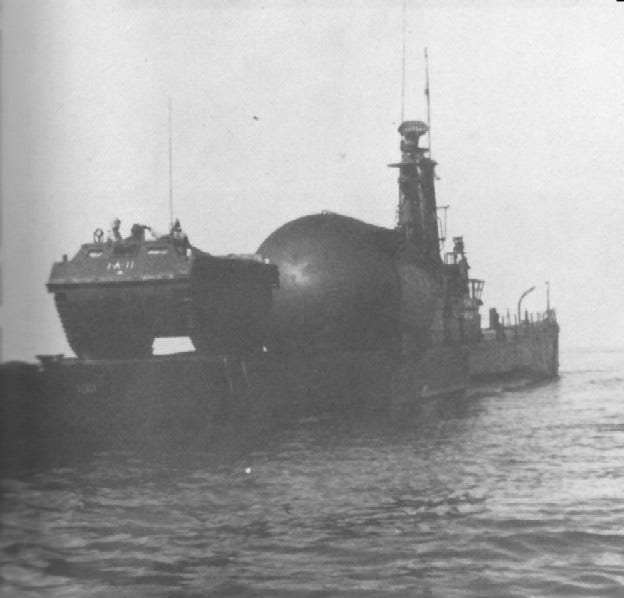
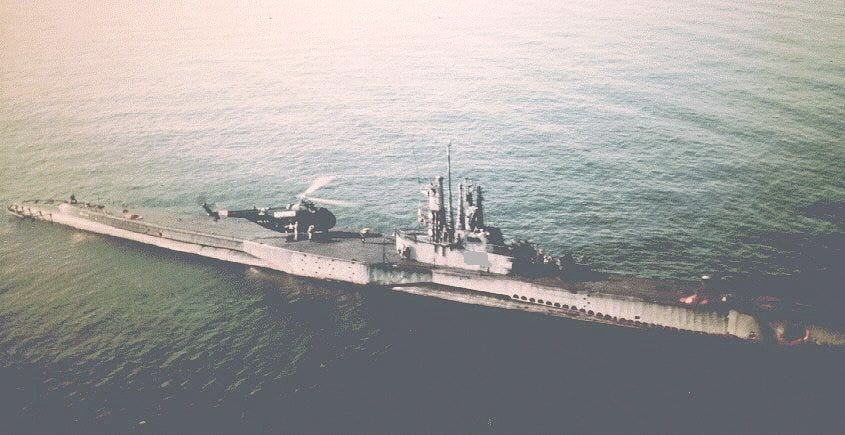
The Perch (SS-313) and Sealion (SS-315) were converted into troop transports in 1948, at Mare Island and San Francisco respectively, so that each could carry 115 soldiers. A hangar behind the conning tower allowed it to carry an LVT, a Jeep, a 75 mm (2.95-inch) gun and inflatable boats seating 8–10. The Perch tested its installations during the Korean War: on the night of 1–2 October 1950 it landed 67 Royal Marines tasked with destroying a railway tunnel; this was the only combat mission by an American submarine during that conflict, and the only significant amphibious action since Attu in 1943! The Perch then took part in exercises at Subic Bay (Philippines) during the Vietnam War (Exercise “Jungle Drum III” in 1965), then, from November 1965, landed Marine reconnaissance teams in South Vietnam ahead of several major operations. It was by then fitted with two 40 mm deck guns and a 12.7 mm (.50-cal) machine gun on the conning tower, which allowed it to intervene on behalf of the landed troops during Operation “Deckhouse III” in August 1966, when combat swimmers came under Viet Cong fire.
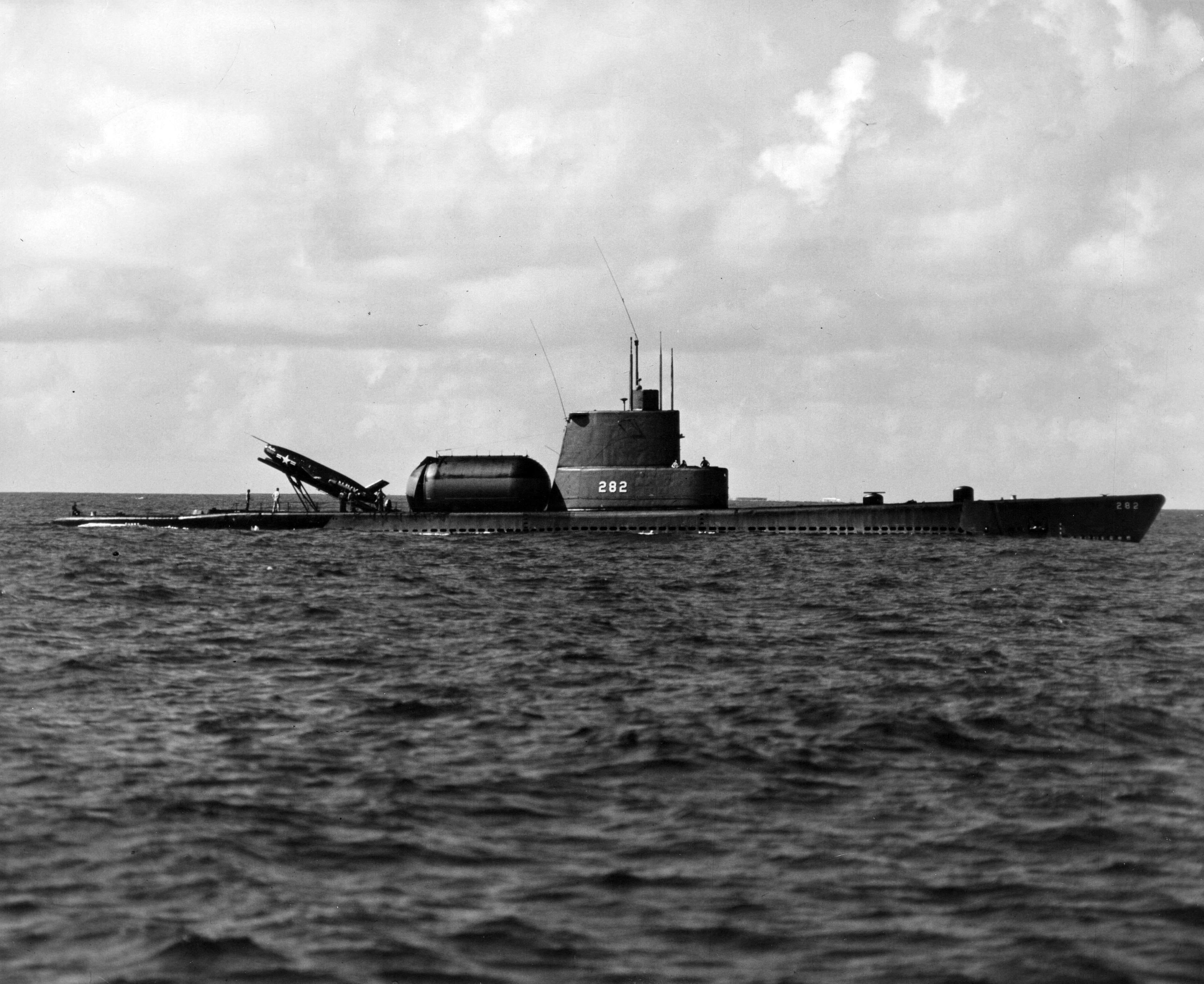
The Tunny (SS 282) was a former Regulus submarine converted into an APSS in 1966 at Puget Sound. It began operational service in February 1967 off Vietnam. It was proposed as a special-forces “taxi” for two operations at Wonsan and Haiphong in 1968, but both plans were ultimately cancelled by high command. As technology evolved and disarmament treaties came into effect, between 1966 and 1993 the US Navy also reclassified a number of its missile launchers as troop transports. Here we stray somewhat from our subject, for the new installations were by then intended for special forces alone. This was done by fixing two large watertight containers (or by fitting out the existing ones on boats that already carried them) to the deck of Regulus (Grayback) or Polaris2 (Sam Houston, John Marshall, Kamehameha and James K. Polk) submarines. They could hold 65 commandos or combat swimmers with their gear while retaining their torpedo tubes.
Final Projects, Final Abandonments
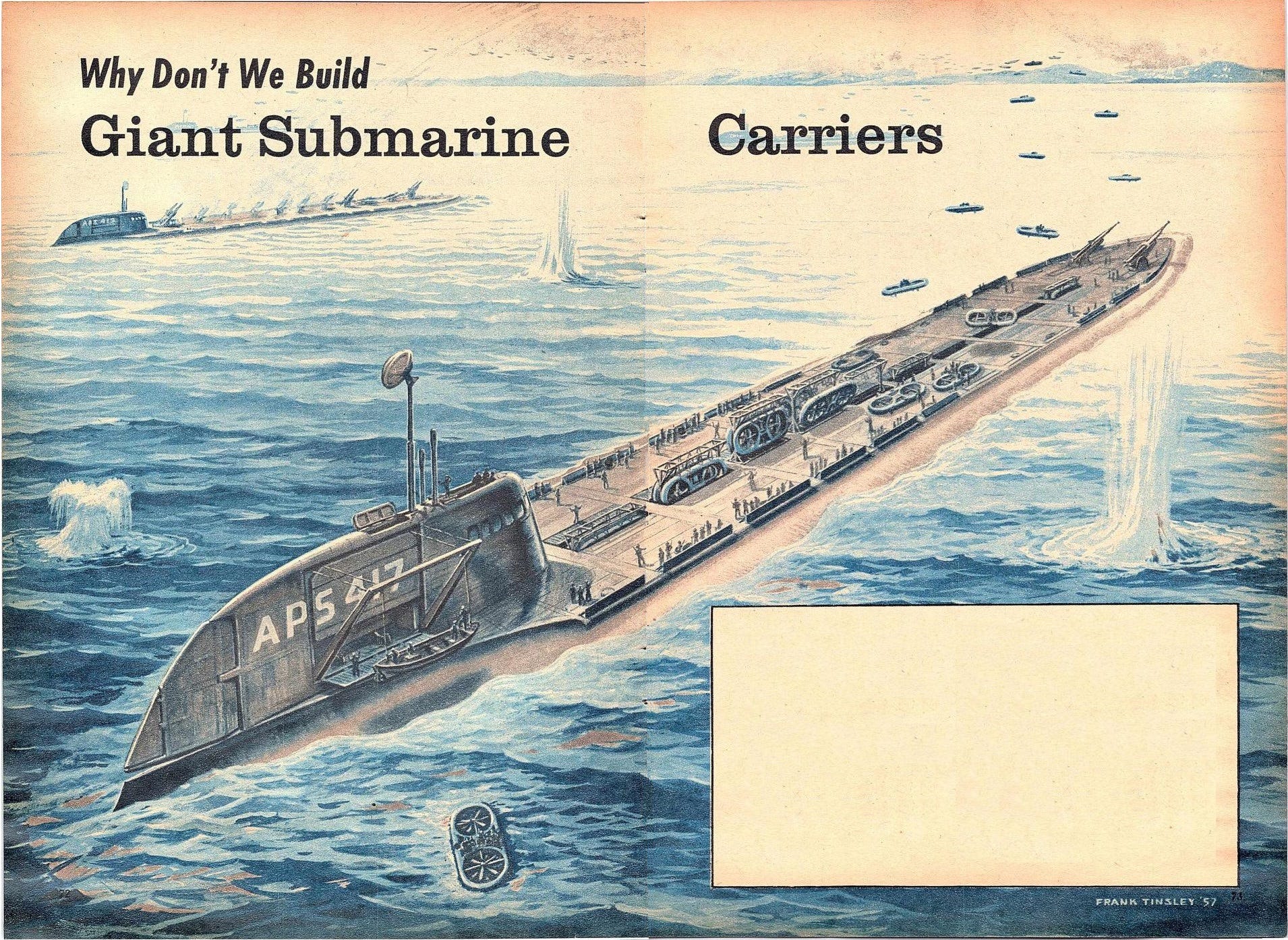
Thus the US Navy always preferred converting existing boats to building craft specially dedicated to transport, even if that meant restricting their use to a fringe of its armed forces. The Cold War being what it was, it did nonetheless consider such a submarine, witness the draft of a monster more than 172 m (564 ft) long, and even that of another stillborn giant 220 m (722 ft) long, able to carry 2,240 Marines, their equipment, and even “air rafts” — highly futuristic amphibious flying troop-transport barges!
In fact, it was the civilian sector that looked most seriously at several cargo-submarine projects. The East-West confrontation brought about a resurgence of the “U-boat menace,” for in the 1950s, facing the USSR, the Western allies felt much as they had in 1940 facing Germany: they still depended just as heavily on the Atlantic and Pacific sea lanes to move raw materials and troops from America to Europe, while the Soviet Union remained a continental empire. With access to warm seas via the Arctic, the Black Sea and the Pacific, Soviet submarines could have wrought havoc among Allied merchant shipping if the war “heated up”... And so submarine transport was seriously considered, particularly after the Nautilus’s cruise beneath the North Pole in August 1958: nuclear propulsion rekindled the interest of the Electric Boat Company’s engineers, who in December of that year presented three designs for “tankers” of 20,000, 30,000 and 40,000 DWT.3 Since their draft was not to exceed 11 m (36 ft) so they could enter certain ports, their outer hull was almost rectangular! They reached — on paper — 37 to 42 knots with one to four nuclear reactors. In 1960 many experts thought the project feasible, but political constraints led to its abandonment in the 1970s: the decision to exploit Alaskan oil meant that the pipeline/surface-tanker pairing was preferred over cargo submarines.
And Among the British?
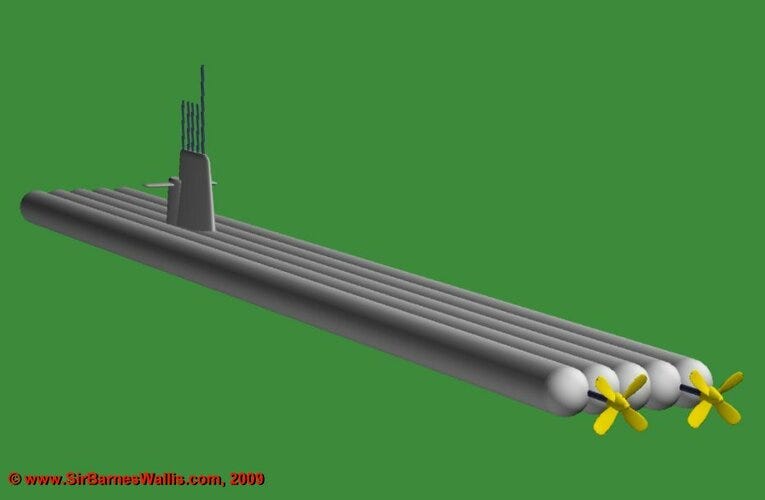
In the 1960s, the engineer Barnes Wallis drew up the general plans for a gigantic cargo submarine to carry oil and strategic materials (ores, and so on). Sir Barnes Neville Wallis was no ordinary figure: an aeronautics specialist at Vickers, he was the man who conceived the bouncing bombs dropped by Lancasters to destroy three German dams in May 1943 (Operation “Chastise”); he also designed the Tallboy (5.5 tons / 12,000 lb) and Grand Slam (10 tons / 22,000 lb) earthquake bombs in 1944–45, before turning to the principle of variable-geometry wings and to that of rocket-powered torpedoes. By his calculations, a given cargo could be carried faster — and with less power expended — by a submarine than by a conventional surface vessel. He proposed a hull made up of several small-diameter cylindrical tubes, a solution more resistant to the great pressures of the depths and better suited to carrying heavy loads. Propulsion drew on the air-independent principle of the Walter gas turbine that was to have powered the Type XVII and Type XXVI U-boats and that the British studied very seriously after the war. Operating in a closed circuit, with no need for fresh air, the system would have run on liquid oxygen stored aboard. The British authorities would ultimately reject the project which, though technically interesting, would not have offered a significant advantage.
The SSM-N-8A Regulus was a nuclear-armed surface-to-surface cruise missile in US Navy service from 1955 to 1964.
The UGM-27 Polaris was a two-stage solid-fueled nuclear-armed submarine-launched ballistic missile (SLBM), in US Navy service from 1960 to 1981.
Deadweight tons (DWT). The only merchant-shipping unit expressed by weight, it is the total carrying capacity (crew, provisions, cargo, and so on).
 | A guest post by
|